In this article
How AI Is Transforming the Role of the Customer Success Manager
The Customer Success Manager isn't being replaced by AI — the role is being promoted. Here's how CSMs become orchestrators of verifiable, math-backed agents that run the repetitive work at scale.

By Pulkit Banta
Frontend Developer
Oct 03, 2025
4 min read
Last Updated: Apr 21, 2026
TL;DR — The CSM role isn't being replaced by AI. It's being promoted. The best teams are turning Customer Success Managers into orchestrators of verifiable, math-backed agents that handle the repetitive work at scale. The catch: most "AI for CS" tooling today can't be trusted with that promotion. Here's what changes in the role, and what has to change with it.
A new wave of writing says AI is coming for the CSM. We think the opposite is happening. The role is about to expand — dramatically — but only for teams that can tell the difference between AI that sounds smart and AI that can prove itself.
The old CSM role is hitting its ceiling
Three pressures keep growing on today's CSMs, all at the same time:
Portfolios keep expanding. 60, 80, 120 accounts per CSM is the new normal.
Customer reality is distributed across product events, tickets, calls, Slack, and contracts — no single system holds the truth.
Leaders want proactive churn prevention, measurable value delivery, and faster time-to-value, without adding headcount.
The result is a role spent reconstructing the same story over and over: pre-QBR fire drills, renewal surprises, reactive escalations. That pattern doesn't scale with more dashboards.
What "AI for CS" has mostly gotten wrong
Most "AI" shipped into CS teams so far looks like one of three things — and none of them is trustworthy enough to hand the wheel to:
Black-box health scores. Retention scores dressed up as churn predictors. No precision/recall, no explanation of signals, no lineage.
Nice-sounding summaries. A meeting recap that reads well but can't tell you why the account is at risk or which signals changed when.
Copilots that hallucinate. Chat-over-your-CRM built on raw LLMs: schema is guessed every call, "same question, different answer" is normal, and nothing is auditable.
We wrote more on the last one in Why Not Just Connect Claude Directly to Your Enterprise Data? and FunnelStory vs. Claude. The short version: handing an LLM raw enterprise data and asking it to also figure out the math is how you get a tool nobody on the CS floor trusts by Friday.
The orchestrator model: what actually changes
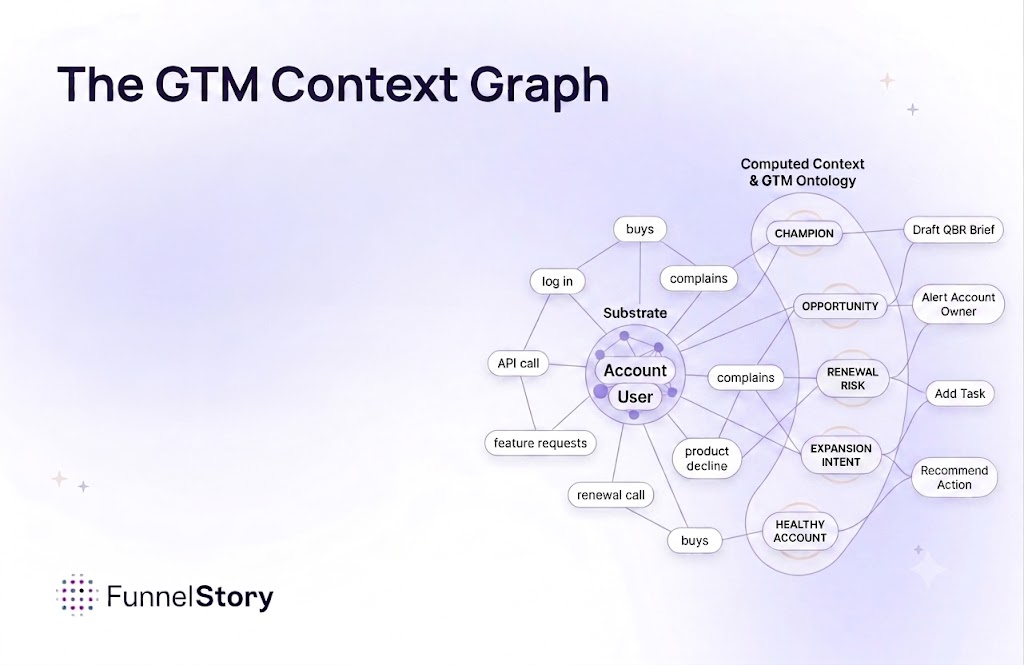
Trustworthy AI moves CSMs from producing the intelligence to orchestrating it. An Intelligence Graph — pre-computed health, risk, adoption, sentiment, stakeholder context — becomes the shared source of truth. Agents run playbooks against it. The CSM is the conductor.
The next great CSM isn't watching a dashboard. They're running queries, cross-checking evidence, and making defensible calls faster than the old role ever could.
Four shifts in the daily CSM workflow
1) From dashboard-watching to pattern interrogation
Instead of "is this account red, yellow, or green?" the question becomes "which accounts match the usage-drop + ticket-spike + stakeholder-change pattern we saw before last quarter's churn wave?" The graph answers that. The CSM prioritizes from it.
2) From triage to evidence-backed action
When the agent flags a risk, it shows its work: the signals, their timestamps, the prior accounts that exhibited the same pattern. CSMs act on evidence they can defend — to customers, to their own leadership, and to themselves.
3) From QBR-prep marathon to continuous narrative
QBR decks aren't reassembled from five tools the week before. They're generated from the same intelligence the CSM uses every day. The account story is always current; the meeting is a decision, not an archaeological dig.
4) From gut calls to auditable recommendations
The agent proposes "send this value-recap to the economic buyer now" or "escalate to the VP; the three signals are X, Y, Z at dates A, B, C." The CSM approves, edits, or rejects. Every action leaves a paper trail.
The skills that compound in this world
Empathy and storytelling still matter — more than ever, for the conversations that actually decide renewals. What gets newly decisive is:
Pattern reading. Knowing what to look at in the graph, and why.
Prompt discipline. Framing questions so agents return useful, checkable answers.
Judgment on evidence. Calling the AI wrong when it's wrong, confidently.
Portfolio composition. Running a book of 100+ accounts with pod-level metrics instead of account-level firefighting.
These are learnable. Teams that invest in them pull away from teams that don't.
Where FunnelStory fits
FunnelStory exists because the orchestrator model only works if the intelligence layer is trustworthy. The Customer Intelligence Graph ingests from 37+ sources, pre-computes the meaning — health drivers, adoption milestones, risk patterns, stakeholder maps — and exposes it to agents and CSMs through queries that return the same answer every time. The LLM sits at the end of that pipeline — synthesizing and formatting, not guessing at math.
That's the technical precondition for turning a CSM into an orchestrator. Without it, AI is another dashboard. With it, the role genuinely expands.
AI isn't replacing CSMs. It's promoting them — but only on teams that refuse to trust AI that can't show its work. If you want to see what orchestration looks like on a real book of business, request a demo.