In this article
The Quantum Future of Customer Success Teams
Discover how AI is rewiring customer success with new roles, empathetic leadership, and organizational design. Learn about FunnelStory AI fits in this new organisational archetype

By Alok Shukla
Cofounder and CEO
Oct 11, 2025
4 min read
Last Updated: Apr 21, 2026
TL;DR AI isn’t replacing CS — it’s rewiring it. The rest of this piece shows how: new roles built on McKinsey’s M-, T-, and AI-augmented archetypes; new ways to lead with empathy and precision; and a new organizational design in which humans orchestrate AI for scale. The future of CS is intelligent, fast, and deeply human-led.

Understanding M-, T-, and AI-Augmented Roles in the Agentic Era
McKinsey’s Agentic Organization framework highlights three key role archetypes reshaping how teams work:
M-Shaped Supervisor: Broad generalists fluent in AI who coordinate human and AI agents to drive outcomes across domains.
T-Shaped Expert: Deep specialists with strong domain expertise who optimize workflows, ensure quality, and handle edge cases.
AI-Augmented Frontline Worker: Human-facing professionals who use AI tools to scale empathy, speed, and personalization.
Together, these archetypes turn traditional CS teams into adaptive networks where humans lead, specialize, and amplify AI performance.
The New Cast of Roles
Role | Future Archetype | Core Focus | Superpower |
|---|---|---|---|
Customer Success Manager (CSM) | M-Shaped Supervisor | Orchestrate hybrid human–AI workflows for full-lifecycle outcomes | AI fluency, orchestration, systems thinking |
CS Operations (CS Ops) | T-Shaped Expert | Design and maintain AI-first workflows, ensure data integrity | Deep analytics, workflow architecture, and ethical AI governance |
Customer Success Leader (CS Leader) | Strategic Orchestrator | Define vision, governance, and culture for the human–AI CS ecosystem | Strategic foresight, organizational design, AI governance, and leadership |
Frontline CS Team | AI-Augmented Connector | Use AI insights to deliver value with empathy, at scale | Contextual intelligence, communication, and trust-building |
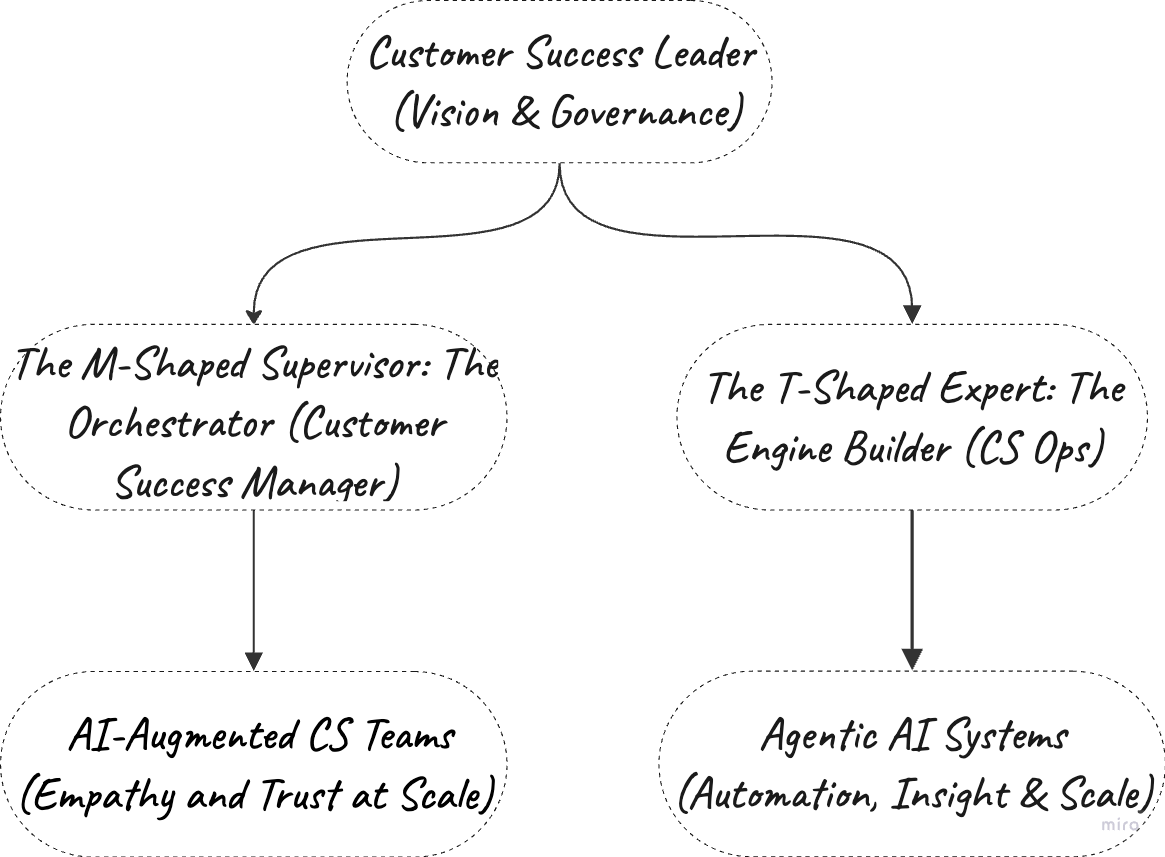
1️⃣ The CS Leader: The Strategic Orchestrator
CS Leaders will set the tone for a new era of Customer Success — one that’s guided by intelligence, empathy, and accountability. They:
Define and communicate the vision for AI-integrated Customer Success.
Govern the ethical use of AI and data transparency across all CS operations.
Align customer outcomes with company strategy through AI-driven insights.
Build cultures of learning, adaptability, and empathy.
Drive collaboration between product, sales, and AI teams to scale customer value.
Think: Visionary architect balancing governance, innovation, and trust.
2️⃣ The M-Shaped Supervisor: The Orchestrator (Customer Success Manager)
As outlined in the role table, this archetype represents the Customer Success Manager (CSM). CSMs act as the bridge between AI precision and human empathy, orchestrating workflows that ensure customers achieve measurable outcomes. You’re the conductor, not the operator. Your hybrid team includes people and AI agents. You:
Steer agentic workflows across the lifecycle.
Translate AI insights into human actions.
Fine-tune systems for fairness, performance, and trust.
Balance scale with empathy.
Think: Strategic depth across AI, empathy, and leadership.
3️⃣ The T-Shaped Expert: The Engine Builder (CS Ops)
CS Ops is the new power core. You:
Build AI-first systems for onboarding, adoption, and engagement.
Govern data pipelines and bias detection.
Integrate agentic workflows across CRM and product ecosystems.
Manage exceptions where AI needs context.
Think: Precision architect with broad collaboration instincts.
4️⃣ The AI-Augmented Connector: The Human Edge (Frontline CS Professionals)
This archetype represents the frontline Customer Success professionals, not AI agents. These are the humans who leverage AI insights to personalize engagement, scale empathy, and build trust across every interaction. Your AI copilot surfaces the signals; you bring the story. You:
Lead conversations that translate data into customer value.
Use AI recommendations to personalize engagement at scale.
Act as the emotional and ethical anchor in every relationship.
Think: Human intuition amplified by AI intelligence.
Bringing it together:
Structure: Pod-based networks — 2–3 M-shaped supervisors + 1 T-shaped expert + 50–100 AI agents.
Culture: Empathy, transparency, and continuous learning.
Metrics: Focused on customer value delivered with empathy at scale, not just operational throughput.
The Bottom Line: Orchestrate or Be Orchestrated
Customer Success isn’t about executive playbooks or dashboards — it’s about delivering value with empathy, at scale. The best teams won’t just use AI; they’ll choreograph it. Those who master this balance between human connection and algorithmic intelligence will define the next decade of Customer Success.
Frequently Answered Questions
Q: What are the key benefits of adopting an AI-integrated CS model for businesses? A: Businesses can achieve significant benefits, including increased operational efficiency, improved customer satisfaction through personalized and timely support, better retention rates due to proactive issue resolution, and enhanced scalability without a proportional increase in human resources. Platforms like FunnelStory AI can help orchestrate these benefits by providing the tools for seamless AI integration.
Q: What role does "empathy at scale" play in the future of AI-augmented Customer Success? A: Empathy at scale means using AI to understand customer needs and sentiments more deeply and then empowering human professionals to deliver tailored, empathetic responses efficiently. AI provides the insights, but humans provide the emotional intelligence and nuanced understanding that builds lasting trust and value.
Q: How can FunnelStory AI help my organization transition to this new era of Customer Success? A: FunnelStory AI provides advanced tools and platforms designed to facilitate the integration of AI into your CS workflows. From enabling M-shaped supervisors to orchestrate human-AI teams to empowering AI-augmented frontline workers with contextual intelligence, FunnelStory AI helps you build adaptive networks that drive customer value with precision and empathy.